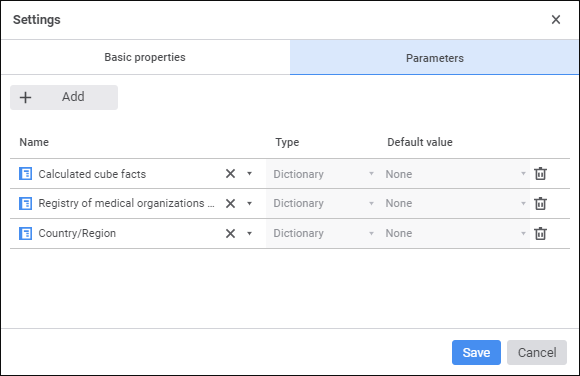
Process parameters can be created on the Parameters tab in the Settings dialog box:
Create process parameters from dictionaries that will be used as parameters. Available operations:
To add a process parameter:
Click the  Add button. A new string is displayed in the parameters list.
Select the required dictionary in the Dictionaries drop-down list. The box is automatically filled with the selected dictionary name.
To quickly select an object, enter object's name/identifier/key in the search box depending on display settings. Search is executed automatically while the searched text is entered into the search string. The list will display the objects, which names/identifiers/keys contain the entered text.
To set up displaying of repository objects in the list of objects, click the  Show Object button and select display option in the drop-down menu:
Name. Objects are displayed with their names. Default option.
Identifier. Objects are displayed with their identifiers.
Key. Objects are displayed with their keys.
Several options can be selected. Identifier and key will be specified in brackets.
After executing the operations the selected dictionary is added to the list of process parameters.
If, during business process execution, one assumes to make changes in the dictionary added to the business process as a parameter, it is recommended for correct work of the business process to set up caching mode by timestamp in the dictionary. To do this, set the IMetabaseObject.CachingMode property of the dictionary to MetabaseObjectCachingMode.FlushCacheByTimestamp.
To avoid data corruption in the dictionary, it is not recommended to start several simultaneous business processes, which make changes in the specified dictionary during their execution.
If it is required to separate user access to instances of the same process, in the process monitoring determine a process key parameter.
To set process key parameter, click the  Consider Access Permissions button next to the required parameter in the list of process parameters. Only one parameter can be a key one.
NOTE. As a key parameter, one can assign only an MDM dictionary.
If the key parameter is set in the process, access to process instances in the process monitoring is determined taking into account user role and discretionary permissions for elements of corresponding dictionary, which determine process instances:
To allow access to process instance, the user should have the read permissions for the corresponding key parameter dictionary element.
If process instance is determined by multiple selection of key parameter, the user should have the read permissions for all corresponding elements of parameter dictionary to access the instance.
If the process instance is determined by zero selection of the key parameter, checking access permissions by parameter dictionary element permissions is not executed.
NOTE. Access to parameter dictionary elements is allowed during MDM dictionary setup.
If key parameter is not set in the process, the process instance is available for the user/user group specified in the Owner box on the active step side panel.
To manage displayed parameter elements in the Start Parameters area in the Start Process dialog box, use parameter filtering. When the process is being started, one can select only the parameter elements that will satisfy the specified conditions.
Available filtering types:
Filtering by value. Filtering is executed by a specific value.
Filtering by parameter. Filtering is executed dynamically by means of the attribute contained in the parameter dictionary.
To set parameter filtering:
Click the  Filter by Parameter button next to the required parameter in the list of process parameters. The Filter Parameters dialog box opens:
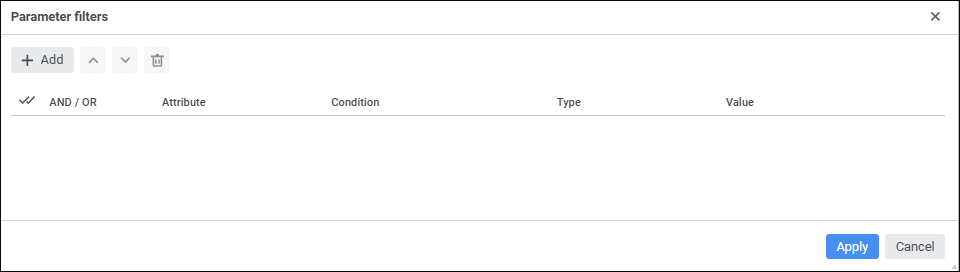
Click the Add button. A new row to set up condition will be added to the table.
In the Attribute column select the parameter dictionary attribute, for which filtering condition will be checked.
Select one of the condition types in the Condition column:
Equal.
Not Equal.
Less Than or Equal.
Less Than.
Greater Than or Equal.
Greater Than.
Contains.
Does not Contain.
Contained In.
Not Contained In.
Do not Intersect.
Begins With.
Ends With.
NOTE. Displayed condition types depend on the data type of the attribute selected in the Attribute column.
Select the type of compared value in the Type column:
Value.
Parameter.
Select the value for the selected filtering type in the Value column:
Specify the compared value for the Value type.
Select the compared value in the drop-down list of process parameter dictionary attributes for the Parameter type. The list contains attributes of parameter dictionaries corresponding to the attribute data type from the Attribute column.
If the parameter dictionary attribute is linked with another dictionary, linked dictionary attributes can be selected as a value.
Repeat the steps to add several filtering conditions:
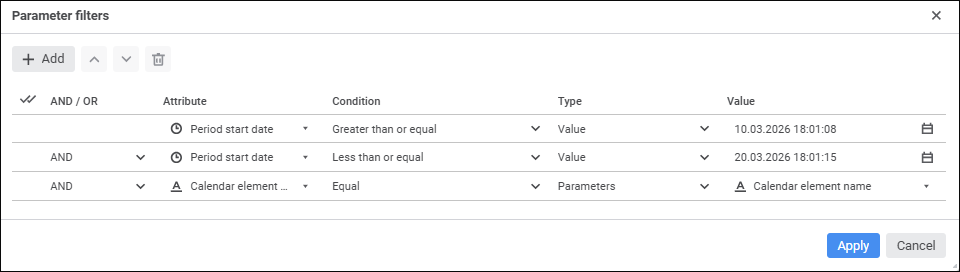
After executing the operations, parameter filtering is set up.
NOTE. Parameter elements are filtered when all filtering conditions are satisfied.
To reorder execution of conditions, select the checkbox in the first column next to the condition and use the  Move Filter Up and
  Move Filter Down buttons.
To delete the filtering condition, select checkbox next to the condition in the first column and click the  Delete button.
To delete all conditions:
Click the  Select All button.
Click the Delete button on the toolbar.
To delete the process parameter, click the Delete button in the required parameter string.
After creating parameters, set up process events on the Events page if required.
See also:
Setting Up Process Parameters | Setting Up Basic Properties | Setting Up Events

 Add a parameter