 Open the Changed Data group of parameters
To set up formatting of data changed in a table but not saved, use the Changed Data group of parameters on the side panel:
 Open the Changed Data group of parameters
To open the Changed Data group of parameters:
Select a cell or a cell range in the table.
Click the  Parameters button on the toolbar.
Select the Data area type in the drop-down menu of the side panel title.
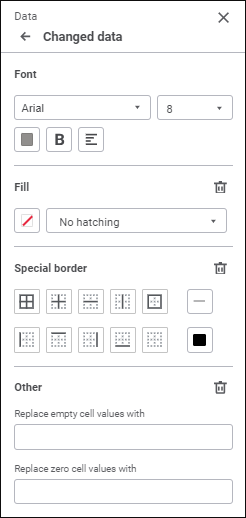
Set the parameters:
Set up font parameters:
Font. Select one of the available fonts in the drop-down list. If required, one can load custom fonts.
Font size. Select the required font size. The size is set in points, and it can be selected in the drop-down list or entered manually. The range of available values: [6; 36].
Color. Select font color in the drop-down color palette. One can select standard and custom colors. The palette contains only standard colors by default.
To create a custom color:
Click the  Add Color button. The advanced color palette opens.
Select a color in the advanced color palette, use color picker to select color on a browser page, or set color code in the RGB or HEX format.
After executing the operations the custom color is created and added to the palette.
NOTE. The maximum possible number of custom colors in the a palette is 23.
To delete custom color from the palette, select the Delete item in the selected color's context menu.
Font style. Select font style:
B. Bold. One can also use CTRL+B to set this font style.
I. Italic. One can also use CTRL+I to set this font style.
U. Underline. One can also use CTRL+U to set this font style.
NOTE. As a rule, the CTRL+U hotkey combination is reserved in the browser for opening source code of the current page. To use this hotkey combination for underlining text, redefine its purpose in browser settings.
S. Strikethrough. One can also use ALT+SHIFT+5 for this purpose.
When the button is pressed, the corresponding font style is used. Several styles can be used simultaneously, for example, pressed B and I buttons result in bold italic font style.
Cell text alignment. Set text alignment relative to cell:
Left. It is used by default. One can also use CTRL+SHIFT+L to set this option.
Center. One can also use CTRL+SHIFT+E to set this option.
Right. One can also use CTRL+SHIFT+R to set this option.
NOTE. As a rule, the CTRL+SHIFT+R hotkey combination is reserved in the browser for refreshing the current page. To use this hotkey combination for aligning text to the right, redefine its purpose in browser settings.
By Width.
Only one option can be selected.
To set up fill, set the parameters:
Fill Color. In the drop-down color palette of the Fill Color button select fill type and determine necessary settings.
The following fill options are available:
No Fill. Click the  No Color button. Fill is not used by default.
Solid Fill. Open the One Color tab and select single-color fill color.
Two-Color Fill. Open the Two Colors tab and select start and end colors of two-color gradient. Specify tilt angle if required.
One can select standard and custom colors. The palette contains only standard colors by default.
To create a custom color:
Click the Add Color button. The advanced color palette opens.
Select a color in the advanced color palette, use color picker to select color on a browser page, or set color code in the RGB or HEX format.
After executing the operations the custom color is created and added to the palette.
NOTE. The maximum possible number of custom colors in the a palette is 23.
To delete custom color from the palette, select the Delete item in the selected color's context menu.
Hatching Type. If required, add hatching. The parameter is set to No Hatching by default. The drop-down list contains all available hatching types.
Hatching Color. The parameter is displayed after a hatching type is selected. Select hatching color in the drop-down color palette.
One can select standard and custom colors. The palette contains only standard colors by default.
To create a custom color:
Click the Add Color button. The advanced color palette opens.
Select a color in the advanced color palette, use color picker to select color on a browser page, or set color code in the RGB or HEX format.
After executing the operations the custom color is created and added to the palette.
NOTE. The maximum possible number of custom colors in the a palette is 23.
To delete custom color from the palette, select the Delete item in the selected color's context menu.
Image. To set up a fill with an image, use the Image parameter. The radio button is disabled by default, a cell fill is set up in a standard way. To use an image as a fill, select the radio button. To add an image to cell, click the Select File button.
The image selection dialog box opens. Working with the dialog box depends on the browser in use. After an image is selected, the file name is displayed in the corresponding box, the report sheet cell is filled with the use of the image.
To remove the image, click the  Delete button next to texture name.
To replace the image, click the Select File button again.
After the image is selected, the following elements are displayed:
Download. Click the Download button to export the image used as a fill.
Stretch Image. The checkbox is deselected by default, the cell image corresponds to its original size. Select the checkbox to fit the image to the cell.
To reset fill settings, click the Delete button next to the Fill tab name.
The following parameters to set up cell borders are available:
Show Borders. The parameter is used to set and remove cell borders. The following modes are available:
 . Show all borders.
 . Show only external borders.
 . Show only internal borders.
 . Do not show borders.
Multiple selection is available for single border type modes:
 . Show internal horizontal border.
 . Show internal vertical border.
 . Show left border.
 . Show right border.
 . Show top border.
 . Show bottom border.
To cancel displaying of borders of the selected range:
Click the button in the Special Border group on the side panel.
Click the Do not Show Borders button.
Line Type. Select line type in drop-down menu.
Line Color. The parameter determines a border line color. Select border line color in the drop-down color palette. One can select standard and custom colors. The palette contains only standard colors by default.
To create a custom color:
Click the Add Color button. The advanced color palette opens:
Select a color in the advanced color palette, use color picker to select color on a browser page, or set color code in the RGB or HEX format.
After executing the operations the custom color is created and added to the palette.
NOTE. The maximum possible number of custom colors in the a palette is 23.
To delete custom color from the palette, select the Delete item in the selected color's context menu.
To change color transparency, use the slider or enter value as a percentage.
To reset search border line color, click the No Color button.
To fill in empty or non-zero cells, enter text, number, or characters in corresponding boxes.
The values, with which empty cells are filled, including numeric ones, will not be saved in the data source.
To remove filling for empty or zero cells, click the Delete button.
See also: