
 To display the tab
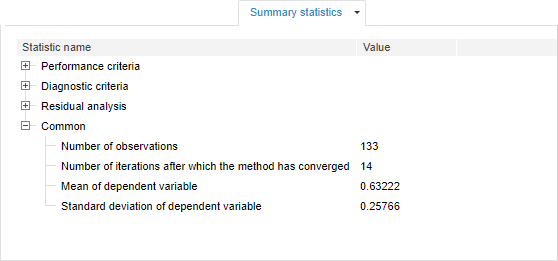
The Summary Statistics tab shows values of various summary statistics calculated for equation.
For example:
Determination Coefficient. It determines the part of variation of the output variable caused by changes in exogenous variables.
Adjusted Determination Coefficient. Determination coefficient, non-sensitive to the number of regressors. The model with the greater value of the criterion is preferred.
Determination Coefficient (Uncentered). Determination coefficient considering the constant in the model.
Adjusted Determination Coefficient (Uncentered). Adjusted determination coefficient considering the constant in the model.
Fisher Statistics. This statistics is used to check the hypotheses about the relation between the explained series and regressors. The null hypothesis on the coefficients equality to zero for all regressors is used.
Fisher Statistics Probability. Probability value for the Fisher statistics. The null hypothesis on the coefficients equality to zero for all regressors is rejected if the probability is less than the significance level (0.1, 0.05, 0.01).
Fisher Statistics (Uncentered). The Fisher statistics calculated based on uncentered determination coefficient.
Fisher Statistics Probability (Uncentered). The Fisher statistics probability calculated based on uncentered determination coefficient.
J-Statistics Probability. Probability value for J-statistics. The null hypothesis on the coefficients equality to zero for all regressors is rejected if the probability is less than the significance level (0.1, 0.05, 0.01).
Standard Error. The measure of average scattering of explanatory variable values about model values.
Log-Likelihood Function. Log-likelihood function is used to regression model tests for redundant or missing variables.
Akaike Information Criterion. The criterion is used to compare models with different number of parameters when it is required to select the best set of explanatory variables. A model with a smaller criterion value is preferred.
Schwarz Information Criterion. Similarly to the Akaike criterion, this criterion is used to select a set of explanatory variables. A model with a smaller criterion value is preferred.
HQ-criterion. It is used to select the best model based on the correlation between selection quality and the number of estimated parameters. The criterion is calculated only for models with binary multiple choice and models with trimmed data. The lower the criterion value, the better.
Durbin-Watson Statistic. A test to check the presence or absence of time correlation in the system errors.
Lower Limit Probability. Probability value for the lower limit of the Durbin-Watson statistic.
Upper Limit Probability. Probability value for the upper limit of the Durbin-Watson statistic.
Sum of Squared Residuals. The sum of squared differences between the modeled and actual values of the explained variable in the sample period.
Mean Error. Mean error.
Mean Squared Error. Mean squared error of original values of the explained variable from the model values.
Root Mean Squared Error. A square root of the mean value of deviation squares.
Mean Absolute Error. Mean absolute error of the original values of the explained variable from the model values.
Residual Variance. Deviations variance.
Standard Deviation of Residuals. The measure of how wide residuals are scattered around their mean.
Jarque-Bera Statistics. It is used to check the hypothesis on the normal sampling distribution.
Maximum Absolute Error. The maximum difference between the modeled and actual values of the explained variable in the sample period.
Number of Observations. The number of observations included in the model sample period.
Number of Iterations after which the Method has Converged. The number of iterations of the calculation, in which a solution is obtained.
Average of Dependent Variable. The average value calculated on observations of the explained variable at the sample period.
Standard Deviation of Dependent Variable. Standard deviation calculated on the observation of the explained variable at the sample period.
See also: