Select the object in the Navigator section.
Click the  Dependent Objects button on the toolbar.
Setting up permissions for dependent objects enables the user to set up permissions for all objects used by this object or which use this object.
To set up access permissions for dependent objects:
Select the object in the Navigator section.
Click the Dependent Objects button on the toolbar.
After executing the operations the Discretionary Access Control and Mandatory Access Control tabs are displayed for the selected object.
NOTE. The ability to set mandatory access control permissions depend on the configured security policy.
When setting up dependent object permissions, use the Discretionary Access Control tab:
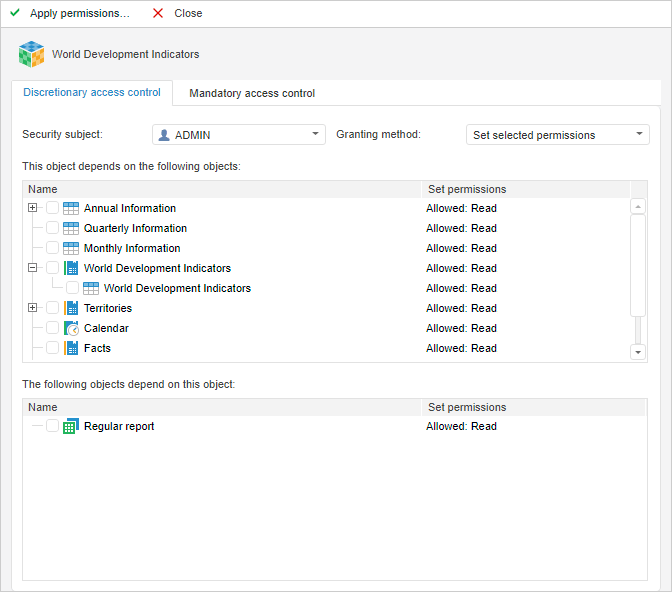
The access permission setup includes:
Object. Name of the source object, for which dependent objects are considered, is displayed in the box.
Security Subject. In the drop-down list select the security subject, for which one should set up access permission for dependent objects.
Granting Method. In the drop-down list select the method of applying access permissions for dependent objects:
Set Selected Permissions. Permissions of the selected objects will be replaced with permissions of the source object.
Add Selected Permissions. Permissions of the source object will be added to permissions of the selected objects.
This Object Depends on the Following Objects. All dependent objects are displayed in the list (by descending hierarchy).
The Following Objects Depend On This Object. All dependent objects are displayed in the list (by ascending hierarchy).
Apply Permissions. The column displays object permissions mismatching source object permissions.
Select checkboxes of the objects, permissions for which should be changed.
NOTE. The objects, which permissions mismatch permissions of the source object, are marked in red. For those objects checkboxes are selected automatically.
When setting up dependent object permissions, use the Mandatory Access Control tab:
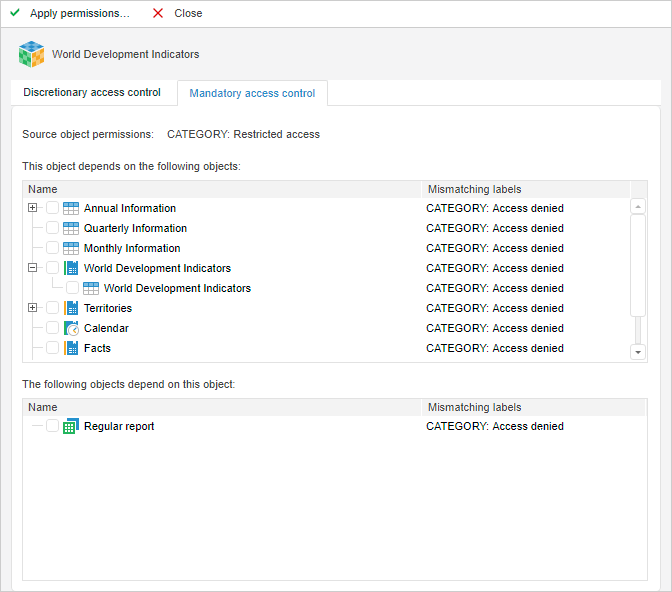
The access permission setup includes:
Source Object Permissions. The box contains security labels of all security categories for the source object. If all categories do not fit the available space, a tooltip is displayed on mouseover on this box.
This Object Depends on the Following Objects. All dependent objects are displayed in the list (by descending hierarchy).
The Following Objects Depend On This Object. All dependent objects are displayed in the list (by ascending hierarchy).
Mismatching Security Labels. The column displays object security labels mismatching source object labels in the format: <category name>: <level name>.
Select checkboxes of the objects, security labels of which should match the source object labels.
NOTE. The objects, which permissions mismatch permissions of the source object, are marked in red. For those objects checkboxes are selected automatically.
To view and change access permissions for the selected object, use the Discretionary Access Control/Mandatory Access Control tab on the Properties side panel.
To apply permissions for the selected objects, click the Apply Permissions button. After this the action confirmation dialog box opens. If the answer is positive, object permissions will be changed taking into account the method for granting source object permissions in discretionary or mandatory access control.
When the user moves to another section, a request to confirm permissions for selected objects is displayed.
See also:
Setting Up Discretionary Access Control Permissions | Access Control Settings