Excel
The Excel connector is an object that is used to export data to Microsoft Excel files (*.xls or *.xlsx).
After adding the connector to the ETL task working area set export options and edit connector input and output.
Export Options
On the properties panel one can select an option for saving the output export file and set data export options.

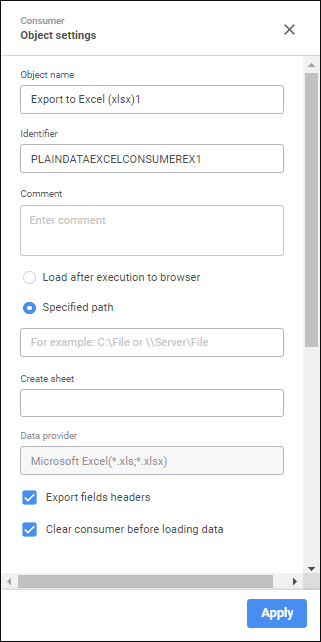
The following parameters can be set up:
Object Name. If required, change connector name.
Identifier. If required, change object identifier. Identifier should be unique with the ETL task. Usage of Latin letters, numbers and the "_" character is allowed. The identifier should start with a letter.
NOTE. If required, add a note to an object. The note can contain any information.
Operation with Ready File. Select where a file will be sent after data export:
Load After Execution to Browser. The radio button is deselected by default. Select the radio button to open the file in the browser after export is finished.
Specified Path. The radio button is selected by default. Set path and name of the file, to which data will be exported, in the corresponding box.
Create Sheet. Set name of the sheet that will be created in the file and to which data will be exported.
Export Fields Headers. The checkbox is selected by default. Column headers will be displayed in the file first row during export. To display exported data to the first row, deselect the checkbox.
Clear Consumer Before Loading Data. The checkbox is selected by default. All information is deleted from the data consumer before loading.
If an event handler was set in ETL task settings, the OnError event is generated in case of errors. One can also determine further export object behavior in case of errors:
Action Executed on Error Occurrence. Select the action executed in case of errors during data loading:
Stop Task Calculation. If export error occurs, ETL task execution is stopped.
Skip Only Incorrect Records. Incorrect records are skipped. Select this option if it is not essential whether all records are present.
Skip All Records In One Transaction. All records of the transaction where an error has occurred are skipped. Select this option if it is necessary to divide records collection into transactions to get all data without exceptions within these transactions.
When the Stop Task Calculation or Skip Only Incorrect Records options are selected, the task is also divided into transactions, and the specified number of records affects speed of task execution.
Export Errors. The checkbox is deselected by default, and errors that occurred during ETL task execution are not exported. After selecting the checkbox select where information about errors will be loaded:
Load After Execution to Browser. After export is finished, the browser opens a page with the errors list.
Specified Path. Set the path and name of the file, to which the errors list will be exported.
Stop Execution if Specified Number of Records are Skipped. The checkbox is deselected by default. To stop ETL task execution, select the checkbox and specify the maximum number of error records, after which export will be stopped.
Number of Records Processed in One Transaction. Specify the number of records processed within one transaction in the corresponding box. 1024 records are processed by default.
Call the Event if Error Occurred. Selecting the checkbox allows for selecting the custom event that will be generated in case of error. The list contains the events created in custom metadata of the repository. An event can be tracked in the task scheduler, tasks should be set up for execution after custom event.
Editing Input
To set a list of fields and link to input, go to the Input Editor tab.
 To display the Input Editor tab
 Settings button.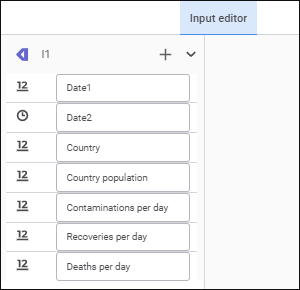
The following settings are available on the page:
 Create Link button and select an object output. If the list of provider and consumer fields fully matches, all fields will be linked automatically. A link between fields can also be set up in the
  Actions button and select the Fill from Consumer item.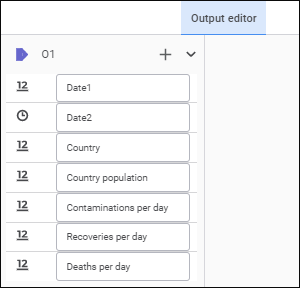
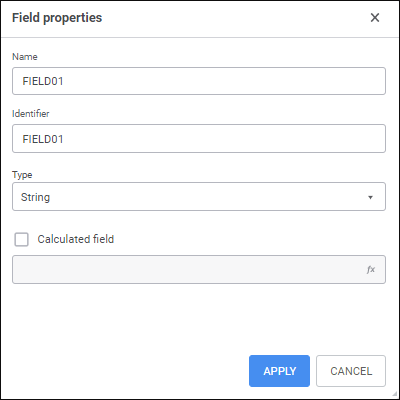
 Add button. The Field Properties dialog box opens: